
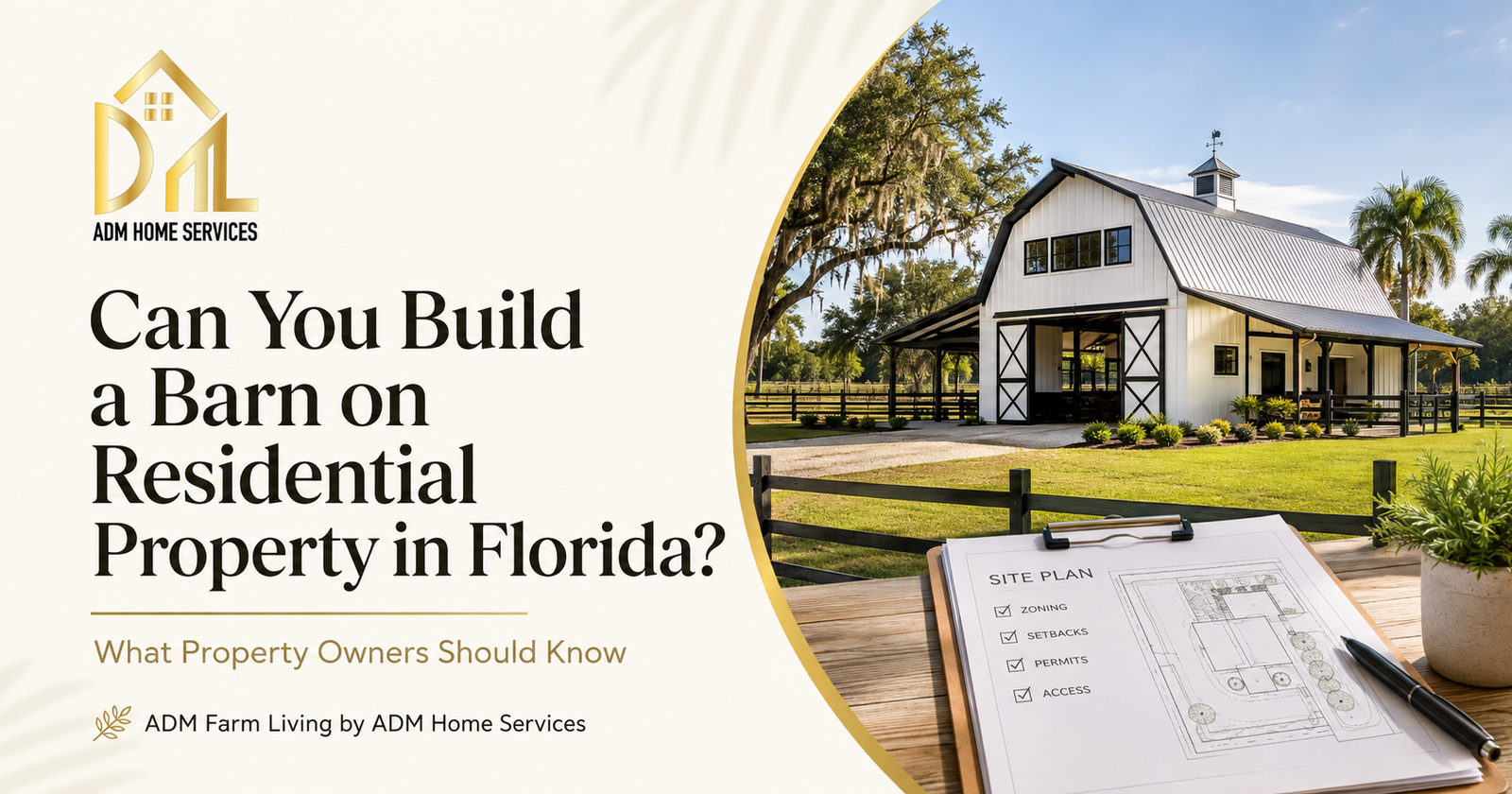
A Barn on Residential Property
You have the property. You have space. Maybe you are thinking about horses, goats, chickens, equipment storage or simply creating the hobby farm lifestyle you have always wanted.
So, can you build a barn on residential property in Florida?
In many cases, yes — but owning a large residential property does not automatically give you the right to build a barn or keep farm animals.
Before choosing a barn design or ordering materials, you need to understand the property’s zoning, permitted uses, setbacks, building requirements, flood conditions and, in some situations, its agricultural classification.
This is especially important in South Florida, where regulations can change significantly from one city or county to another.
ADM Farm Living is a specialized service of ADM Home Services, a Florida licensed and insured general contractor. We help property owners look at the entire property — home, barn, animals, fencing, access and future improvements — before construction begins.
Here’s what you should know.
1. Start With Zoning — Not the Barn Design
The first question should not be:
What size barn can I build?
It should be:
Does my property’s zoning allow the use I have in mind?
Every property is assigned a zoning classification. That classification determines not only what structures may be built, but also which activities are permitted on the property.
Miami-Dade County, for example, explains that zoning districts establish permitted land uses along with requirements such as setbacks, building area, height and open space.
And the differences can be significant.
Miami-Dade’s standard RU-1 single-family residential zoning allows customary residential accessory uses such as sheds and private garages. However, the county separately prohibits keeping horses, cattle, goats and poultry in its single-family residential districts.
By contrast, Miami-Dade’s EU-2 five-acre estate district specifically allows agricultural uses along with single-family residences.
Same county. Very different possibilities.
That’s why acreage alone is not enough.
2. A Barn and the Animals Inside It Are Two Different Zoning Questions
This is an important distinction.
A property might allow an accessory structure but not necessarily allow the livestock you intend to keep there.
For example, a structure that could legally serve as storage may not automatically become a legal goat barn, chicken house or horse stable.
Before planning construction, determine:
- Is the structure itself permitted?
- Are the animals permitted?
- Is there a minimum lot size?
- Are there animal-number limitations?
- Are additional setbacks required from neighboring homes?
- Is commercial activity prohibited?
- Are there HOA or deed restrictions?
This is why the phrase “I have enough land” does not necessarily answer the zoning question.
3. Residential Barn or Agricultural Building?
Not every barn in Florida is legally treated the same way.
A barn constructed as an accessory structure on a residential property may be subject to the Florida Building Code and local permitting requirements.
A qualifying nonresidential farm building on land used for bona fide agricultural purposes may fall under a different set of rules.
Florida Statute 604.50 provides an exemption from the Florida Building Code and county or municipal building codes for certain nonresidential farm buildings, farm fences and farm signs located on land used for bona fide agricultural purposes. However, floodplain-management regulations remain applicable.
That does not mean:
“It’s a barn, so I don’t need a permit.”
The property and proposed use have to qualify.
4. Don’t Assume a Hobby Farm Automatically Qualifies for an Agricultural Exemption
This is one of the areas where property owners can easily become confused.
Having:
- chickens,
- goats,
- a vegetable garden,
- a few acres,
- or a building that looks like a farm barn
does not by itself guarantee that the property qualifies for Florida’s agricultural-building exemption.
Palm Beach County, for example, has a formal process for agricultural building-permit exemptions and states that the property must meet specific eligibility requirements, including designation as agricultural land by the Palm Beach County Property Appraiser.
So before relying on any exemption, verify it.
Planning around an exemption that ultimately does not apply can cost far more than confirming the requirements at the beginning.
5. Setbacks Can Determine Where the Barn Goes
Even when the structure is allowed, you cannot necessarily put it wherever you want.
Zoning may establish minimum distances from:
- Front property line
- Rear property line
- Side property lines
- Streets
- Main residence
- Other structures
- Wells
- Septic systems
- Easements
- Neighboring residences
Accessory structures can also have different setbacks from the principal home.
For example, Miami-Dade’s EU-1 one-acre estate zoning lists separate requirements for principal buildings and accessory uses.
On an acreage property, those restrictions can significantly affect the usable portion of the lot.
This is one reason a survey and basic property layout should be reviewed before selecting the barn location.
6. Think Beyond Today’s Barn
Suppose you find a legal location for a 1,200-square-foot barn.
Great.
But what happens two years later when you want:
- another paddock;
- additional fencing;
- a workshop;
- chicken area;
- feed storage;
- greenhouse;
- guest house;
- additional driveway;
- trailer parking;
- outdoor living area?
Building the barn in the first available location may create conflicts later.
A better approach is to think of the entire acreage property as a small master plan:
Home → driveway → barn → animal areas → fencing → equipment → water → drainage → future structures
You do not need to construct everything at once.
But today’s barn should not block tomorrow’s plans.
7. Barn Access Is More Important Than It Looks on Paper
A barn needs more than four walls and a roof.
Think about how people, animals, vehicles and equipment will actually move through the property.
Ask:
- Can a feed delivery vehicle reach it?
- Can a horse or livestock trailer turn around?
- Can emergency vehicles access the structure?
- Where will hay or feed be unloaded?
- Where will equipment be stored?
- How wide do the gates need to be?
- Can animals move safely between paddocks?
- Will trucks have to cross areas used by children or animals?
A barn that looks perfectly placed on a plan may become frustrating if it is difficult to access every day.
8. South Florida Drainage Must Be Part of the Barn Plan
One of the biggest differences between building a barn in South Florida and many other parts of the country is water.
Heavy rainfall, flat terrain and flood conditions can turn a poorly planned barn area into a constant maintenance problem.
Before construction, consider:
- Existing grade
- Direction of stormwater flow
- Barn floor elevation
- Roof runoff
- Gutters and downspouts
- Paddock drainage
- Driveway drainage
- Low areas
- Flood-zone requirements
Poor planning can result in muddy entrances, standing water and animal areas that become difficult to use during rainy periods.
Even Florida’s agricultural-building exemption does not remove applicable floodplain-management requirements.
9. Should You Build a Pole Barn or an Enclosed Barn?
This depends entirely on the intended use.
A pole barn may make sense for:
- Equipment storage
- Hay storage
- Open animal shelter
- Tractor protection
- Covered work areas
- Certain livestock uses
An enclosed barn may be better for:
- Horse stalls
- Tack rooms
- Feed rooms
- Secure equipment storage
- Workshops
- Veterinary or wash areas
- Climate-sensitive storage
For some properties, the best solution may combine open and enclosed areas.
The decision should consider more than initial price.
Think about:
- wind exposure;
- rain;
- ventilation;
- animal comfort;
- security;
- future use;
- maintenance;
- construction requirements.
We will address this in detail in a future ADM Home Services article comparing pole barns and traditional barns for South Florida properties.
10. Plan for Heat, Ventilation and Hurricanes
A barn in South Florida needs to function in a hot, humid and storm-prone environment.
Design considerations may include:
- Natural ventilation
- Roof design
- Orientation
- Shade
- Durable exterior materials
- Corrosion-resistant components
- Wind resistance
- Protected storage
- Emergency access
- Animal evacuation planning
A structure that works well in a cooler climate may not be the ideal design for South Florida.
This is especially important when internet inspiration comes from farms in Tennessee, Kentucky or other regions with very different environmental conditions.
11. What About a Barn With Living Quarters?
This changes the conversation significantly.
Florida’s agricultural-building exemption concerns nonresidential farm buildings.
Once the project includes residential occupancy, such as:
- apartment;
- guest suite;
- caretaker quarters;
- full bathroom and bedroom;
- barndominium residence;
the project cannot simply be treated as a standard nonresidential agricultural barn under that exemption.
A barn with living quarters should be evaluated as a different type of construction project, including zoning, building-code, septic/sewer, electrical, plumbing and possibly density considerations.
If the real goal is to combine a residence and barn, you may actually be planning a barndominium, which deserves its own feasibility analysis.
12. Can You Build the Barn Before the House?
Sometimes this is possible, but there is no universal Florida rule that makes it automatically permissible.
Some jurisdictions restrict accessory structures from being constructed without an existing principal use or residence. Agricultural properties may be treated differently.
Therefore, if you are purchasing vacant acreage with a plan such as:
Phase 1 — barn
Phase 2 — fencing
Phase 3 — house
confirm the sequence with the applicable zoning and building authority before construction.
The order in which you build can matter.
13. What About Davie, Loxahatchee, Wellington and Other Farm-Living Communities?
South Florida contains communities where acreage and animal-oriented lifestyles are much more established.
But each community has its own rules.
Davie, for example, has an official Hobby Farm checklist within its Planning & Zoning development-review process.
Palm Beach County has separate procedures concerning qualifying agricultural improvements.
Other communities may have different rules for:
- horses;
- chickens;
- livestock;
- barns;
- accessory buildings;
- fencing;
- setbacks;
- agricultural classification.
This is why we do not recommend assuming that something allowed on a neighboring farm will automatically be allowed on your property.
14. A Survey Is One of the Best Places to Start
If you already own the property, locate the current survey if possible.
A useful survey can help identify:
- Property dimensions
- Existing structures
- Easements
- Property lines
- Encroachments
- Some utility information
From there, zoning and other property information can be reviewed to begin determining where a barn and future structures might fit.
If you are still considering buying a property, doing some of this research before closing can be extremely valuable.
15. The Best Barn Project Starts With the Property, Not a Catalog
It is tempting to find a beautiful barn online, select a size and then figure out where to place it.
We recommend reversing that process.
Start with:
1. Property
What can legally and physically be done?
2. Lifestyle
Which animals and activities do you want?
3. Master Plan
Where should the home, barn, fencing and future improvements go?
4. Barn Design
What size and configuration actually fit that plan?
5. Construction
What plans, permits, professionals and trades are required?
The result is more likely to be a property that works well for years rather than simply a barn that fits today.
ADM Farm Living Is Part of ADM Home Services
ADM Farm Living is a specialized service of ADM Home Services, created to help South Florida property owners plan and build properties designed around acreage, animals and a more connected outdoor lifestyle.
It is not a separate construction company.
Farm Living projects benefit from the construction experience, project management and licensing of ADM Home Services, a Florida licensed and insured general contractor.
Depending on the property and scope, our team can assist with:
- Property construction feasibility
- Site planning coordination
- Barn construction
- Animal shelters
- Custom homes
- Home additions
- Workshops and storage structures
- Fencing and gates
- Driveways and exterior improvements
- Permit coordination
- Licensed trades
- Inspections
- Construction management
Florida Certified General Contractor — CGC1537357
Thinking About Building a Barn on Your Property?
Before purchasing a barn package, paying for construction drawings or deciding where the structure should go, find out what your property can actually support.
Tell us:
- Where the property is located
- How much land you have
- Which animals you plan to keep
- What type of barn you are considering
- What you may want to build in the future
Through ADM Farm Living by ADM Home Services, we can help identify the construction questions that should be answered before you move forward.
Discuss Your Barn Project
ADM Farm Living by ADM Home Services
Florida Certified General Contractor
CGC1537357
Zoning, permitted animal uses, agricultural classifications, building requirements and exemptions vary by property and jurisdiction. This article provides general information and is not a determination of what is permitted on any specific property.