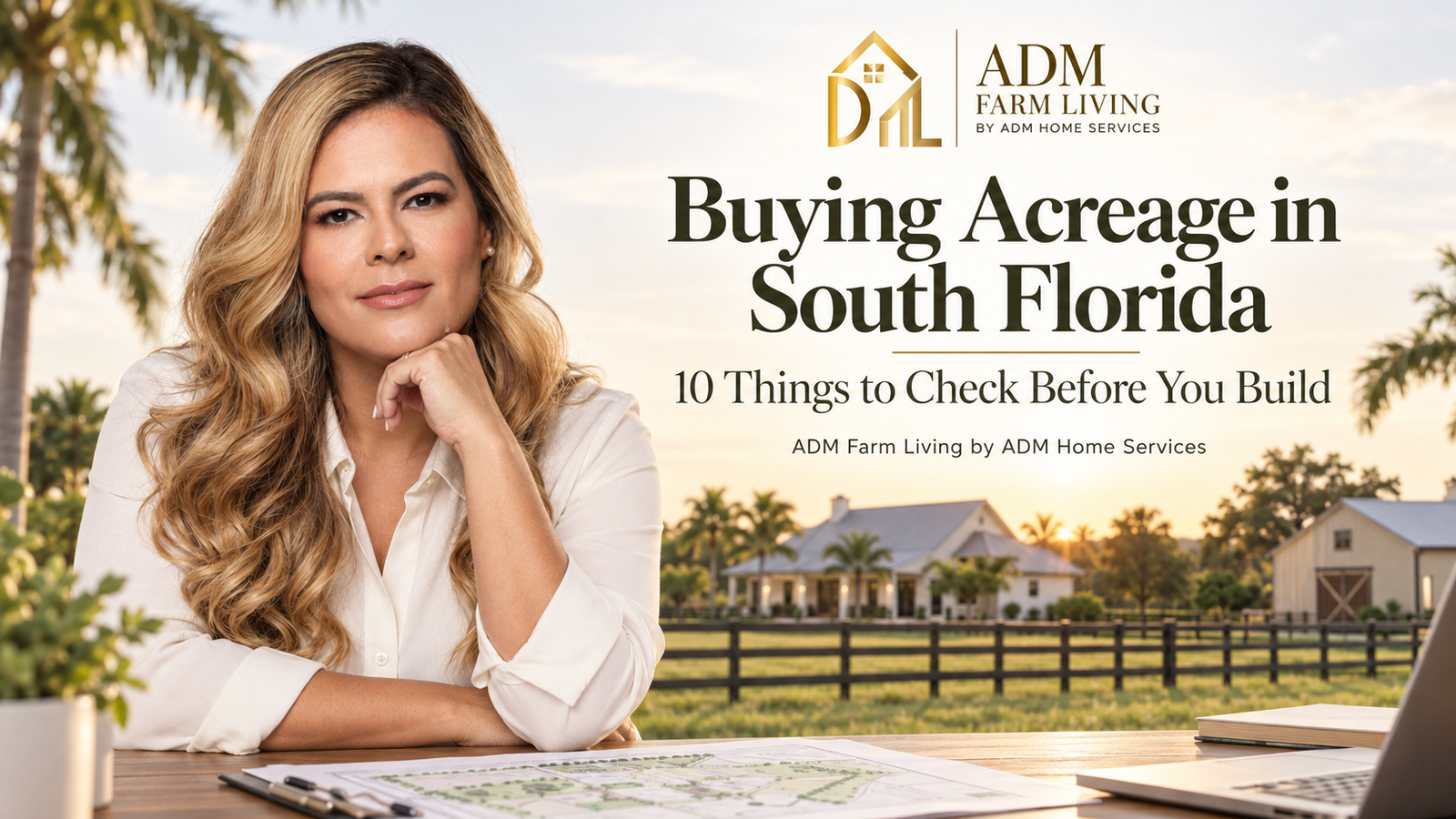

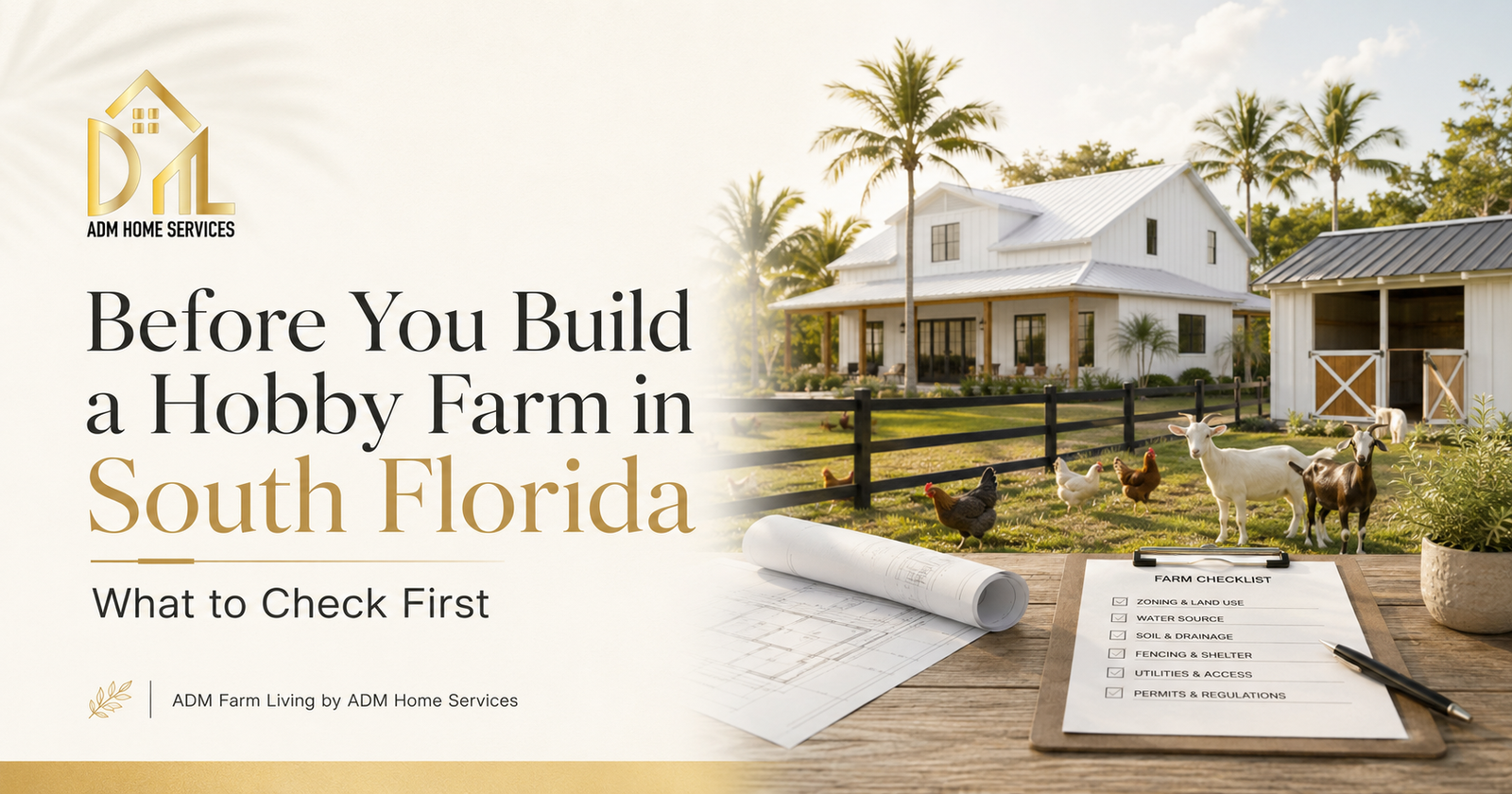
A few acres, a comfortable home, chickens in the yard, maybe goats, horses or a small barn. For many families, the idea of creating a hobby farm in South Florida represents something bigger than owning more land. It is about having more space, being closer to nature and creating a different way of living.
But before designing the barn, choosing fencing or deciding where the animals will go, there is an important question to answer:
What can you actually do with the property?
Building a successful hobby farm starts with understanding the land, zoning, local regulations, drainage, utilities and how all the pieces of the property will work together.
Through ADM Farm Living, a specialized service of ADM Home Services, our team helps South Florida property owners evaluate, plan and build functional acreage properties designed around their home, animals and lifestyle.
ADM Home Services is a Florida licensed and insured general contractor, CGC1537357.
Here are some of the most important things to consider before you start.
1. Start With the Property’s Zoning
Having a large lot does not automatically mean you can keep livestock or build any type of agricultural structure.
Every property has a zoning classification that determines permitted uses and development conditions.
Miami-Dade County, for example, explains that each property is assigned a zoning district that determines allowable land uses as well as requirements such as height, area, open space and setbacks.
Davie even has specific criteria and procedures related to Hobby Farms, demonstrating how local regulations can differ significantly from one South Florida community to another.
Before purchasing land or investing in plans, determine:
- What is the property’s zoning?
- Are agricultural or animal uses permitted?
- What accessory structures are allowed?
- What setbacks apply?
- Are there restrictions on the number or type of animals?
- Are there HOA or deed restrictions in addition to municipal rules?
This should happen at the beginning, not after the design is complete.
2. Decide What Kind of Farm Living You Actually Want
“Hobby farm” can mean completely different things to different families.
One property owner may want:
- Chickens
- A vegetable garden
- A greenhouse
- A small storage building
Another may envision:
- Goats
- Cows
- Horses
- Paddocks
- A barn
- Feed storage
- A workshop
- Equipment areas
Those decisions affect how much usable land you need and how the property should be organized.
They can also affect zoning.
For example, Miami-Dade County prohibits horses, cattle, goats and poultry in certain single-family residential districts, illustrating why the property classification must be checked before assuming animals are allowed simply because a lot is large.
Choose the lifestyle first. Then determine whether the property can support it.
3. Look at Usable Acreage, Not Just Total Acreage
A listing may say a property has two, five or even ten acres.
That does not necessarily mean every square foot can be used for construction or animal areas.
Usable land may be affected by:
- Building setbacks
- Easements
- Drainage areas
- Existing structures
- Septic systems
- Wells
- Wetlands
- Flood zones
- Utility locations
- Access requirements
- Required separation between structures
- Local zoning restrictions
This is why asking “How many acres do I need for a hobby farm?” does not have one universal answer.
A well-planned two-acre property may work better for a particular family’s goals than a poorly organized five-acre property.
4. Think About the Entire Property Before Building One Structure
One of the biggest planning mistakes is deciding where to build the barn before thinking about everything else.
Instead, consider the property as one complete system.
Think about where you may eventually need:
Home → Driveway → Barn → Animal Areas → Paddocks → Fencing → Feed Storage → Equipment → Water → Garden → Drainage
Even if you plan to build the property in phases, having an overall concept from the beginning can prevent expensive conflicts later.
For example, the perfect location for today’s chicken coop might eventually interfere with a future driveway, barn, guest house or drainage system.
At ADM Farm Living, we believe the goal should not simply be to add individual structures.
The goal should be to create a property that works as a whole.
5. Pay Special Attention to Water and Drainage
Water management matters everywhere, but it is especially important in South Florida.
Before deciding where to place barns, shelters, animal areas or driveways, understand how water moves across the property.
Poor drainage can create:
- Muddy animal areas
- Standing water
- Difficult equipment access
- Driveway problems
- Erosion
- Unusable paddocks
- Moisture around structures
Floodplain requirements may also apply even to certain agricultural improvements that otherwise qualify for exemptions.
Palm Beach County specifically notes that qualifying nonresidential farm buildings on land used for bona fide agricultural purposes may receive exemptions from some building-code requirements, while floodplain-management regulations still apply.
Drainage should therefore be part of the property plan, not an afterthought.
6. Understand the Difference Between a Hobby Farm and a Bona Fide Agricultural Property
This distinction can be very important.
Florida law provides certain exemptions for qualifying nonresidential farm buildings, farm fences and farm signs located on land used for bona fide agricultural purposes. The law does not mean that every barn, shed or structure built on a large residential property automatically qualifies. Floodplain regulations are also specifically excluded from that exemption.
Palm Beach County has its own review and documentation process for agricultural improvements and qualifying farm structures.
This is one reason homeowners should be cautious when they hear statements such as:
“You don’t need a permit because it’s a farm.”
The correct answer depends on the property’s use, classification, proposed structure and local jurisdiction.
Verify first.
Build second.
7. Plan for Utilities Early
A beautiful piece of acreage can become much more complicated once you start asking practical questions:
- Where will the house get water?
- Is there municipal water or a well?
- Is sewer available or will the property need septic?
- Where can the septic system be located?
- How will electricity reach a barn or workshop?
- Where will animals get water?
- Will future structures require additional electrical capacity?
- How will outdoor lighting be handled?
Utility planning can affect where structures should be located and what the overall project will cost.
If you are still evaluating a property, these questions should be investigated before finalizing your construction plans.
8. Design Around the Daily Routine
Farm-inspired properties should not only look beautiful in photographs.
They need to make daily life easier.
Imagine actually using the property every morning.
Where is the feed stored?
How far do you carry it?
Can a delivery vehicle reach the storage area?
Can animals move safely between areas?
Can you get equipment through the gates?
Where will you wash equipment or animals?
Can a veterinarian access the property?
Where will manure and waste be handled?
Can a trailer turn around?
A few feet on a drawing can become a major inconvenience when repeated every day for years.
Good farm-living design considers movement, access and routine, not just appearance.
9. Plan Structures for South Florida Conditions
A farm property in South Florida faces a different environment from one in Tennessee, Texas or North Carolina.
Design decisions may need to account for:
- Heat
- Humidity
- Heavy rain
- High winds
- Hurricanes
- Drainage
- Sun exposure
- Ventilation
- Corrosion
- Emergency animal management
Florida is currently operating under the 8th Edition (2023) Florida Building Code, effective since December 31, 2023.
Even when a specific agricultural structure may qualify for an exemption, good construction planning should still consider durability, wind exposure and the safety of the people and animals using the property.
10. Think About Fencing Before Construction Is Finished
Fencing often looks simple until you start planning it.
The layout can affect:
- Animal separation
- Paddock sizes
- Vehicle access
- Gate locations
- Driveways
- Barn access
- Equipment movement
- Maintenance
- Future expansion
Different animals also have different fencing requirements.
The cheapest layout today may become expensive if it needs to be relocated when another structure is added.
Include fencing and gates in the master plan from the beginning, even if they will be installed later.
11. Consider How the Property Could Grow Over Time
You may begin with a house and chickens.
Five years later, the property could include:
- Goats
- Horses
- A barn
- Workshop
- Greenhouse
- Additional storage
- Guest accommodations
- Larger garden
- New paddocks
- Expanded outdoor living
You do not necessarily need to build everything at once.
But the first phase should not prevent the second.
A thoughtful property plan allows the hobby farm to evolve with the family.
12. Develop the Budget Around the Whole Property
When people think about building on acreage, they often focus on the price of the house or barn.
The complete budget may also involve:
- Site preparation
- Surveying
- Architectural or engineering plans
- Permitting
- Drainage
- Driveways
- Clearing
- Utilities
- Septic or well systems
- Fencing
- Gates
- Animal structures
- Electrical distribution
- Outdoor water
- Landscaping
- Storage
Looking at these components early creates a much more realistic picture of the investment required.
It can also help determine which elements should be completed first and which can become future phases.
Before You Buy Land, Ask Better Questions
Many people begin their hobby farm search by asking:
Is this enough land?
A better set of questions is:
Can I keep the animals I want here?
Can I build the structures I need?
Where can those structures legally go?
How will the property drain?
How will water, power and access work?
Can the property grow with my plans?
Finding those answers before investing heavily in drawings or construction can save considerable time and money.
ADM Farm Living by ADM Home Services
ADM Farm Living is a specialized service of ADM Home Services, created for property owners interested in hobby farms, acreage living and properties designed around homes, animals and outdoor life.
Rather than treating the house, barn, fencing and property improvements as unrelated projects, our goal is to help clients look at the property as a complete construction plan.
Depending on the project, our team can assist with:
- Property and construction feasibility
- Site planning coordination
- Custom homes and additions
- Barns and animal structures
- Workshops and storage
- Fencing and gates
- Driveways and exterior improvements
- Permit coordination
- Licensed trade coordination
- Construction management
- Inspections and project closeout
ADM Home Services is a Florida licensed and insured general contractor, CGC1537357.
Already Own Acreage or Considering a Property?
You do not need to have the entire project figured out before contacting us.
Tell us about the property, the animals you would like to have and the lifestyle you are trying to create.
We can help identify the questions that should be answered before you move forward with design and construction.
Start With a Farm Living Property Consultation
ADM Farm Living by ADM Home Services
Florida Certified General Contractor
CGC1537357
Local zoning, permitting, agricultural-use and animal requirements vary by property and jurisdiction. Information in this article is general and should not replace verification with the applicable local authority before purchasing property or beginning construction.